
04.12. to 05.12.2025 Museum für Naturkunde Berlin
Evening event on 04.12.2025 Global IPBES findings on nexus and transformative change in dialogue with policy and practice in Germany
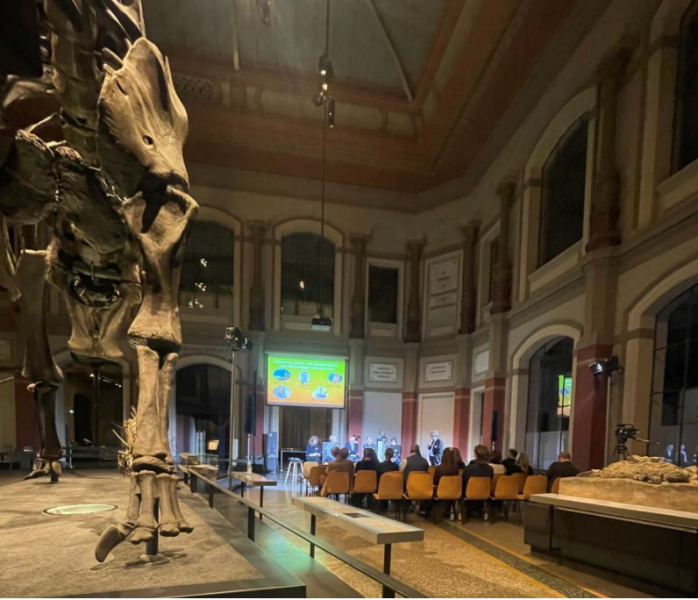
An evening event took place on 4 December 2025 under the dome of the Dinosaur Hall at the Museum für Naturkunde in Berlin. During the evening, the German translations of two IPBES reports were presented. One was the Nexus Assessment, which looks at how biodiversity, climate change, water, food and health are all connected. The other was the report on Transformative Change, which looks at what it takes to bring about deep changes in society. Afterwards, a panel discussed what these reports mean for the German context.
The museum, which normally tells the story of major events in Earth's history, became a place for public exchange about the big questions of our time for this one evening. Climate change and the loss of biodiversity are already destabilizing ecosystems and human wellbeing, and will keep doing so, as shown by the reports from the World Biodiversity Council (IPBES) and the World Climate Council (IPCC). Ambitious goals are set at the global level through conventions on climate change, desertification and biodiversity. But putting climate and biodiversity protection into practice has to happen at the national and local level. The main question of the evening was how these global reports can be given more weight in decision making in Germany.
The evening opened the national workshop organized by the EU funded project RESPIN. Several authors who contributed to the reports gave interesting insights into their content.
- Prof. Ralf Seppelt, coordinating lead author of Chapter 5 of the Nexus Assessment, explained the complex interactions between water, food, energy, climate and biodiversity, and how 72 response options can bring benefits across all these areas together.
- Prof. Tobias Plieninger, lead author of the Transformative Change Assessment, presented how the report was put together and pointed out the barriers that have so far stood in the way of deep change.
- Dr. Yves Zinngrebe, coordinating lead author of the Transformative Change Assessment, presented the key levers for social transformation and made clear that they only work when linked perspectives, structures and practices are addressed together.
The panel that followed turned to the question of how these findings can reach policy and society. The main contact points for translating and spreading the reports are the German IPBES and IPCC coordination offices.
The first speaker on the panel, Dr. Mariam Akhtar-Schuster, head of the German IPBES coordination office, introduced the new direction for the National IPBES Forum. From now on the forum will take place after IPBES plenary meetings rather than before them. This shifts the focus toward transferring results, so that participants can discuss together how the findings can be put into practice in Germany. She then invited everyone to the next forum, which will be held on 26 February 2026 in Berlin. Mariam Akhtar-Schuster and Dr. Christiane Textor, head of the German IPCC coordination office, also highlighted the growing cooperation between IPBES and IPCC, since climate change and biodiversity loss are so closely linked. Christiane Textor pointed out that breaking down global findings for national circumstances is hard given how complex and uncertain many scenarios are. Key challenges include institutional inertia, misinformation, and the sense many people have that these issues don't concern them directly.
Prof. Hans-Otto Pörtner, a lead author of several IPCC and IPBES reports among other roles, stressed how closely climate protection and biodiversity policy are linked. He reminded the audience that these reports are always a joint product of science and policy, and called for more scientific presence in political negotiations to counter misinformation. His message was clear. Without successful climate protection, efforts to protect biodiversity will fail.
Dr. Thomas Schmitt spoke about the IPBES youth workshop, which brought together 25 participants from Europe and Central Asia. There, participants developed strategies to connect response options from the reports with concrete local challenges and case studies, ranging from drought to air pollution. The biggest obstacles are lack of awareness that the assessments even exist, and a lack of resources for implementation. Prof. Tobias Plieninger once again stressed the importance of societal values. What's needed is enthusiasm for transformation and positive narratives that improve both nature and people's everyday lives. Prof. Ralf Seppelt closed with a question. "What comes after the assessment?" His answer was that the results need to be spread, retold, and anchored in both scientific and public formats. New stories should be made visible, such as alternative economic indicators or successful subsidy reforms in other countries.
The evening event in the Dinosaur Hall offered a first look at what it takes to make the assessments usable in the German context. Deeper discussions and concrete applications to different topic areas followed the next day at the National RESPIN Workshop.
National RESPIN Workshop on 05.12.2025
The following day brought the national RESPIN workshop, with a clear goal. Together with experts from science, administration and practice, participants discussed how findings from IPBES and IPCC reports can flow more strongly into decision making and practice in Germany. The aim was to identify barriers and solutions for national knowledge and policy transfer, and to make synergies visible. Four thematic tables discussed how the global assessments apply to German goals on health, agriculture, restoration and sustainable consumption, and what it takes for their findings to actually have an impact in Germany.
In the health discussion, it became clear that the link between biodiversity and human wellbeing needs more attention. Decision makers, from the finance ministry down to municipalities and health insurers, need clear information about the costs of nature loss and the benefits of preventive action. At the same time, communication and working methods between the health, environment and finance sectors need to be better connected.
The discussion on agriculture also showed that climate and biodiversity protection should no longer be treated separately. What's needed are integrated planning and governance approaches, along with advice that is both integrative and specific to individual farms. A necessary shift in narrative became clear too. Agriculture should not be seen only as food production, but as an active contribution to climate and biodiversity protection.
A central topic in the restoration discussion was the conflict between species protection and ecosystem protection, along with the frequent lack of translation from global principles into locally usable strategies. Restoration only works on the ground. This means concepts like paludiculture or biogas need to be planned and financed regionally. Participants also noted that current strategies are often too complex. More translation work, simpler formats and clear local relevance are needed.
On the topic of consumption, the main question was why ecosystems with high integrity are so rarely factored into economic decisions. Political silos, rigid areas of responsibility and a large number of uncoordinated strategies make holistic solutions difficult. What's needed here are harmonized strategies, clear guidelines and ways of communicating that show municipalities and citizens concrete, individual benefits.
To close, participants reflected together on the added value the assessments offer and how this could be highlighted more. Many wanted simple, low barrier formats, especially shareable infographics that briefly explain what the assessment is, why it's new and relevant, what it's used for and how collaboration is built into it. One thing became clear. The global assessments provide valuable, solid foundations. But for them to be truly applied in Germany, they need to be better translated, anchored locally, and prepared in a way that makes them easy to share and that captures public attention.